
The Replicator’s Rise
The Selfish GeneThis thread traces the hypothetical progression from stable matter to copying molecules and then to organisms built as protective vehicles.
increasing Bearing strength in each event
 decreasing
Bearing strength in each eventdecreasingStable Patterns

Before Life
Stability first
The account begins with stable arrangements of matter, from crystals to molecules. Before living organisms existed, physical and chemical processes could already preserve some patterns longer than others.
A prelude to selection
This is not yet biological evolution, but it supplies its logic: durable forms persist. The idea of “survival of the stable” prepares the reader to imagine natural selection arising from simpler beginnings.
The Primeval Soup
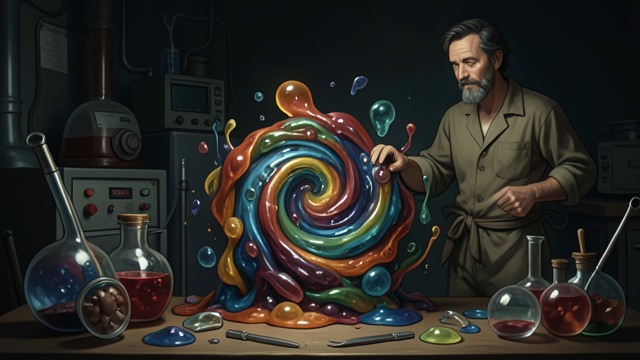
A Chemical Starting Point
Increasing complexity
The book sketches a young world whose simple substances, exposed to energy, could form more complex organic molecules. The proposed setting is a richly supplied chemical environment, not a designed laboratory.
The limits of certainty
The origin story is explicitly speculative. Its role is to show a plausible route from ordinary chemistry toward the conditions in which copying could begin, rather than to claim that every step is known.
A Copying Molecule
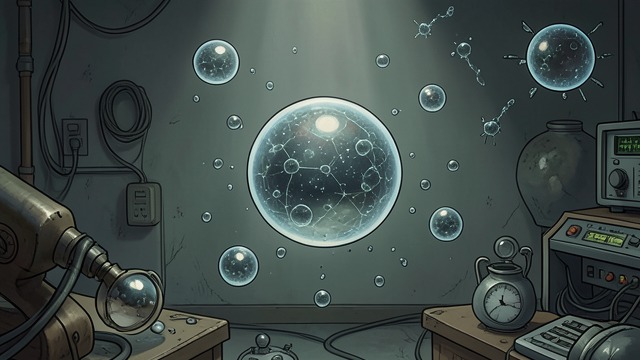
The First Replicator
A remarkable property
At some point, a molecule appears that can generate copies of itself. The book calls this hypothetical entity the Replicator and treats its origin as improbable but possible over immense time.
Copies change the odds
Once copies exist, their numbers can increase without each molecule having to arise independently. Imperfect copying introduces variation, making later differences in survival and reproduction possible.
Competition in the Soup
Scarcity and Selection
Three routes to success
Replicators differ in longevity, speed of copying, and accuracy. Variants with advantages in these qualities can become more common as their copies accumulate.
Rivals and resources
The chemical environment cannot support unlimited copying. As building blocks become scarce, replicators compete, and strategies that disrupt competitors or protect copies can be favored.
The Survival Machine
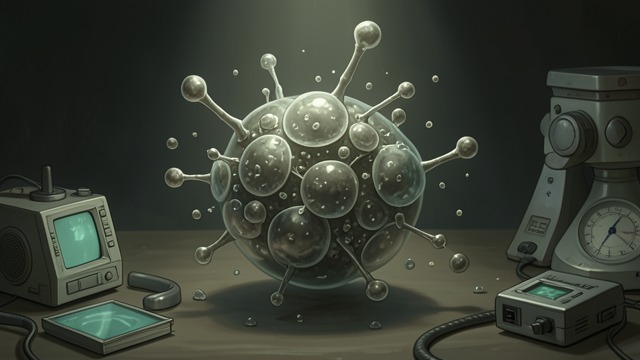
From Molecules to Vehicles
Protection evolves
Replicators that build protective surroundings gain an advantage over exposed molecules. The imagined first survival machines are simple, but competition favors increasingly elaborate defenses and capacities.
A modern inheritance
The story arrives at organisms as gene-built vehicles. Genes persist through the bodies they help construct, while the bodies themselves are temporary, complex means of survival.
At the start of Chapter 2
In the speculative origin-of-life passage
After the chemical soup accumulates complexity
After replicators become numerous
At the end of Chapter 2
